
How to Travel from Cairo to Luxor: Trains, Flights, Buses and Practical Tips
Travelling from Cairo to Luxor connects two very different parts of an Egypt itinerary. Cairo is the place for the Pyramids, museums and historic neighbourhoods, while Luxor offers the temples, tombs and landscapes of ancient Thebes. The distance is roughly 650 kilometres by road, so choosing the right transport can make a noticeable difference to your time, budget and energy.
Most independent travellers choose between a train and a domestic flight. Trains are usually the more practical and atmospheric option, particularly for overnight travel. Flying is much faster, although airport transfers and check-in add time to the short flight itself. Buses and private cars have their uses, while a Nile cruise is better viewed as a multi-day experience than a simple transfer.
For more practical detail, see our Cairo Airport to the City: Transport Options and Costs.
Key takeaways
- Train: the best all-round choice for many travellers, with daytime and overnight services connecting Cairo and Luxor.
- Flight: the fastest option, especially for a short Egypt trip, but compare the complete airport-to-hotel journey rather than flight time alone.
- Bus: a possible budget alternative, although departure points, comfort and schedules vary.
- Private transfer: useful for families, groups or travellers combining Luxor with stops along the way.
- Nile cruise: a slower, experience-led option that normally requires a separate journey to the cruise departure point.
- Check current schedules, fares and ticket rules before travelling because transport arrangements can change.
Table of Contents
- Ways to travel from Cairo to Luxor
- Taking the train from Cairo to Luxor
- Flying from Cairo to Luxor
- Buses and private transfers
- Using a Nile cruise as part of the journey
- Choosing the best option for your trip
- How to plan the journey smoothly
- Staying connected from Cairo to Luxor
- Arriving in Luxor and starting sightseeing
- Frequently asked questions
Ways to travel from Cairo to Luxor
Your choice largely depends on whether you value time, price, sleep or flexibility. A train leaves you in central Luxor, while a flight requires airport transfers at both ends. A bus may be cheaper but can involve a longer road journey, and a private car gives you control over stops at a higher cost.
| Option | Typical experience | Best suited to |
|---|---|---|
| Train | Long-distance rail journey with daytime and overnight services | Independent travellers and those watching costs |
| Flight | Short domestic flight plus airport procedures and transfers | Short itineraries and time-sensitive plans |
| Bus | Long road journey with operator-dependent stops and comfort | Travellers comparing budget options |
| Private transfer | Door-to-door travel with possible scheduled stops | Families, groups and customised routes |
| Nile cruise | Multi-day river journey with sightseeing along the Nile | Travellers making the journey part of the holiday |
If this is your first visit, it can help to plan the transport alongside your sightseeing rather than treating it as an isolated booking. The 7-day Egypt itinerary covering Cairo, Luxor and Aswan shows how the route can fit into a short trip without packing every day too tightly.
For more practical detail, see our Best Time to Visit Egypt: Weather, Crowds and Regional Advice.
Taking the train from Cairo to Luxor
The train is the classic Cairo to Luxor connection. Most services leave from Ramses Railway Station in central Cairo and arrive at Luxor Railway Station, which is also relatively central. The journey is long, but it avoids airport transfers and gives you a direct arrival near the East Bank’s hotels, restaurants and attractions.
Day trains
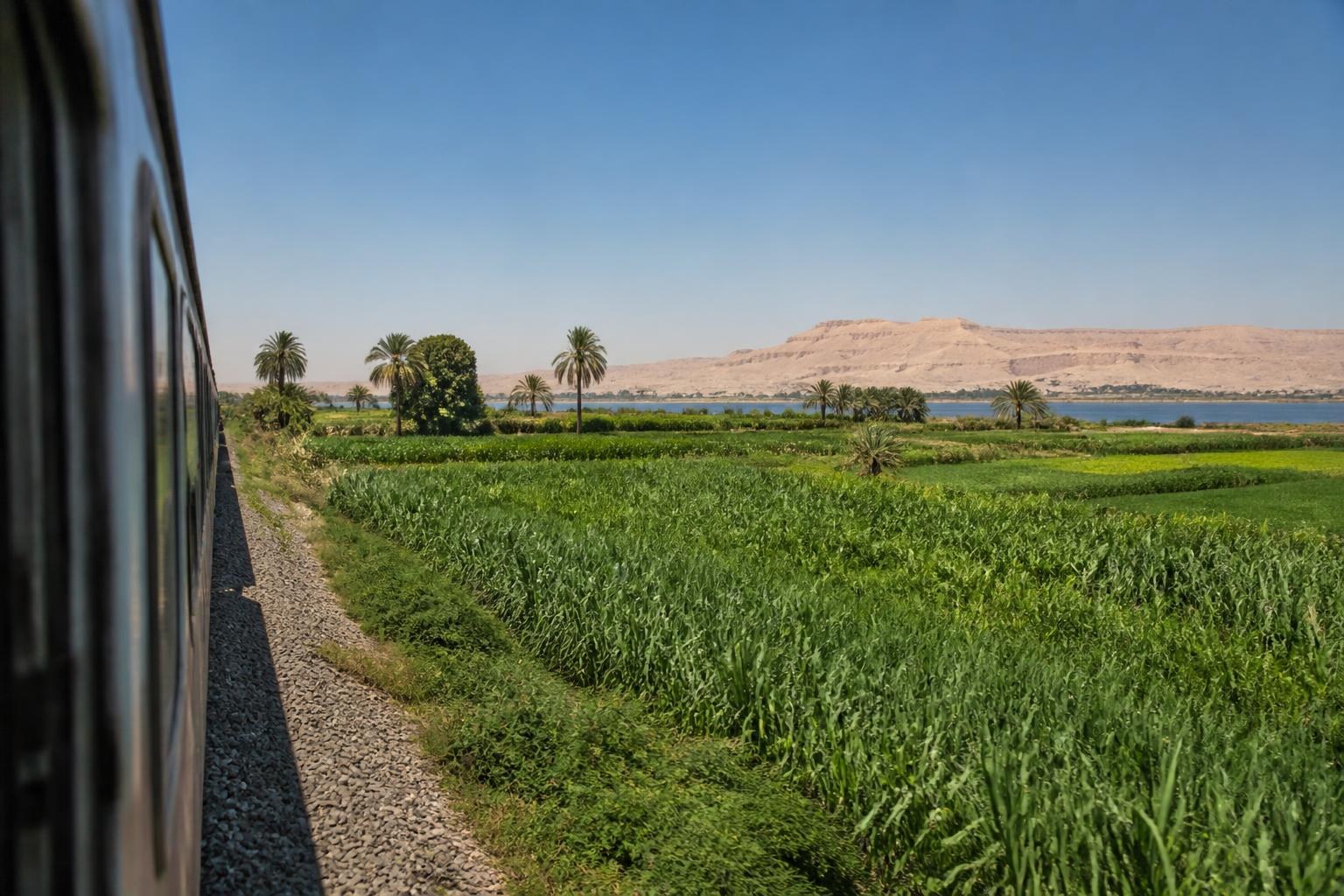
Daytime services commonly take around nine to twelve hours, depending on the train and timetable. The route passes through the Nile Valley, with farmland, towns and desert landscapes visible from the window. It is a good option if you want to travel during daylight and arrive with a normal night’s sleep behind you.
Comfort varies between services and classes. Take water, snacks, tissues, headphones, medication and a light layer because air-conditioned carriages can feel cool. Do not assume that onboard food, clean facilities or reliable power sockets will be available throughout the journey. Keep your valuables and important documents in a small personal bag.
Overnight trains
An overnight departure can save a hotel night and preserve a daytime sightseeing period. The trade-off is that sleep quality varies. Noise, movement, cabin temperature and the standard of the berth may not suit every traveller, so read the current accommodation details carefully before paying.
Confirm whether your ticket is for a sleeping compartment or a seated service. Check the departure station, boarding time, luggage conditions and whether meals are included. Keep your passport, phone, money, medication and other essentials with you rather than leaving them in a large bag away from your berth.
Buying tickets and using the stations
Use the current Egyptian National Railways information and booking channels to check departures, classes and ticket availability. Booking windows and eligibility rules can change, and popular overnight services may sell out during busy periods. Allow extra time at Ramses Station if you have not used it before or are carrying large luggage.
At the Luxor end, confirm whether your accommodation is on the East Bank or West Bank before leaving the station. The West Bank is across the Nile, so a hotel there may require a taxi and a river crossing. If you arrive late, ask your accommodation to arrange or recommend a pickup rather than negotiating while tired.
Flying from Cairo to Luxor
Flying is normally the quickest way to cover the distance. Domestic flights leave from Cairo International Airport and arrive at Luxor International Airport. The flight itself is short compared with the train, but the complete journey also includes Cairo traffic, airport check-in, security, baggage collection and the transfer from Luxor airport to your hotel.
For reliable supporting context on this point, see Egyptian National Railways official booking and timetable information.
For a morning departure, leave central Cairo or Giza with a generous margin. Traffic can be unpredictable, and the airport is not close to the city’s main tourist areas. Check your terminal and baggage conditions before leaving your hotel, particularly if you are travelling with checked luggage.
Luxor International Airport is outside the central sightseeing areas. Arrange a hotel pickup, pre-booked transfer or reputable taxi before arrival if possible. Flying often makes sense when you have only two or three days in Luxor, are connecting with another flight or do not sleep well on overnight trains. It may be less attractive when the fare is high or when your hotel is close to Ramses Station.
Compare the door-to-door cost, not just the advertised airfare. Add transport to Cairo airport, any baggage fee, the transfer from Luxor airport and the value of the time saved.
Buses and private transfers
Bus travel
Long-distance buses can be another way to travel between Cairo and Luxor, but the details are more operator-dependent than they are for the main rail connection. Departure terminals may be outside the area where you are staying, and a journey can occupy much of a day or night.
Before booking, confirm the departure location, whether the service is direct, the expected duration, luggage allowance and the number of stops. Keep valuables with you and avoid arranging an important tour immediately after an overnight bus. If comfort is important, compare the vehicle type and seat layout rather than choosing only by price.
Private car or driver
A private transfer costs more than public transport but can be valuable for families, groups and travellers who want door-to-door service. It also makes it possible to agree on breaks or carefully chosen stops in advance. The road journey is long, and the final duration depends on traffic, rest stops, checkpoints and the route used.
Book through a reputable hotel, established tour company or provider with clear recent reviews. Before departure, confirm the vehicle, pickup address, destination, approximate duration, included stops and payment terms. A very low quote may exclude waiting time, entrance stops or luggage arrangements.
Using a Nile cruise as part of the journey
A Nile cruise is not usually a simple Cairo-to-Luxor transfer. Most conventional cruises operate between Luxor and Aswan, so travellers normally reach Luxor separately, spend time there and then board a cruise for the downstream or upstream itinerary.
This can be an excellent choice if you want accommodation, meals and guided visits combined with a river journey. It is less suitable if you have a tight schedule or want to choose every sightseeing stop independently. Check the embarkation point, sailing date, cabin arrangements, included excursions and hotel nights before booking. Cruise itineraries vary, and the advertised number of nights does not always describe the full time needed for transfers.
If you want mobile data ready before you arrive, compare our eSIM Egypt plans and choose the plan that fits your trip.
Choosing the best option for your trip
If you have limited time
Choose a flight when the fare is reasonable and the airport schedule fits your itinerary. You will gain hours compared with a train, but leave enough space after landing for luggage and the transfer to your hotel. Avoid booking a tightly timed West Bank tour immediately after arrival.
If you want to save money
Compare a standard train with an overnight service. A daytime seat is often the simplest value option, while a sleeper may combine transport and accommodation. Check the actual fare, comfort and arrival time rather than assuming the cheapest ticket is the best deal.
If you are travelling solo
A train is often easier to organise alone than a long private road transfer. Save your booking, station details and hotel address offline. If you arrive at night, arrange onward transport in advance and keep your luggage compact enough to manage without assistance.
If you are travelling with children or heavy luggage
A private transfer reduces station changes and carrying bags, while a flight shortens the main journey. On a train, choose accommodation or seating that keeps your luggage close and bring enough food, water and entertainment for the full trip.
How to plan the journey smoothly
Transport is easier when your Luxor plans reflect the time and location of your arrival. The East Bank is convenient for Luxor Temple, Karnak Temple, the Luxor Museum and many hotels. The West Bank is closer to the Valley of the Kings, Hatshepsut’s Temple and other archaeological sites, but you need to cross the Nile for East Bank activities.
- Check the current schedule. Verify rail, flight or bus details through the relevant operator before paying, especially around public holidays and busy travel periods.
- Allow a realistic buffer. Do not schedule a prepaid tour, airport connection or return journey immediately after your expected arrival.
- Save key information offline. Keep your booking, hotel address, passport details and transfer instructions on your phone, with screenshots available if data fails.
- Pack for a long travel day. Carry water, snacks, sun protection, medication, tissues, a power bank and a light layer. Keep valuables in a small personal bag.
- Plan your first evening gently. After an overnight train or long road journey, check in and rest before attempting a full day of temples and tombs.
For broader arrival, transport and neighbourhood advice before leaving Cairo, see this practical Cairo travel guide. It can help you decide whether to stay near Ramses Station, the airport or another part of the city before your departure.
For reliable supporting context on this point, see Experience Egypt: Practical Information in Luxor.
Staying connected from Cairo to Luxor
Mobile data is useful for checking schedule updates, locating a station, translating messages and contacting your accommodation. Coverage can vary during long stretches outside urban areas, so download maps and booking details before leaving Cairo. A charged power bank is more useful than relying on a train or airport socket.
If your phone supports eSIM technology, you can arrange an Egypt eSIM before travelling and connect soon after landing. Check that your phone is unlocked and eSIM-compatible. The Egypt eSIM guide explains activation, compatibility and when a physical local SIM may be a better choice.
Save the Arabic and English names of your hotel, station and airport. Keep your normal SIM somewhere safe if you remove it, and remember that an eSIM does not replace the need for offline information when signal or battery is limited.

Arriving in Luxor and starting sightseeing
Luxor’s attractions are divided between the East and West Banks. On the East Bank, Luxor Temple, Karnak Temple, the Luxor Museum and many restaurants are relatively easy to combine. On the West Bank, the Valley of the Kings, Valley of the Queens and Hatshepsut’s Temple are spread across a larger area and are usually visited with a driver, guide or organised tour.
After a long train, bus or road journey, avoid trying to cover both banks immediately unless you have plenty of energy. Check in, eat, rest and begin with a nearby attraction. Start early for open-air archaeological sites, especially in warmer months, and carry water, sun protection and comfortable footwear.
Ask your accommodation about current ticket arrangements, transport and guide recommendations. If you are using a taxi or private driver, agree on the destination and price before setting off. For wider preparation, the site’s Egypt travel safety advice covers common transport and practical issues without treating every journey as the same.
Frequently asked questions
What is the best way to travel from Cairo to Luxor?
For many travellers, the train offers the best balance of price, simplicity and central arrival. Flying is better when time matters most, while a private transfer suits groups or customised routes.
How long does the train from Cairo to Luxor take?
Journey times vary by service, but daytime trains commonly take roughly nine to twelve hours. Check the current Egyptian National Railways schedule because departure times and service patterns can change.
Is flying from Cairo to Luxor worth it?
It can be worthwhile for a short trip or when you want to maximise sightseeing time. Compare the complete door-to-door journey, including Cairo traffic, airport procedures, baggage and the transfer from Luxor airport.
Should I book Cairo to Luxor transport in advance?
Advance booking is sensible for flights, overnight trains and organised private transfers, particularly during busy seasons. Confirm the departure point and current ticket conditions, and keep some flexibility if your Cairo plans may change.
Should I stay on the East Bank or West Bank in Luxor?
The East Bank is convenient for the railway station, Luxor Temple, Karnak and restaurants. The West Bank is quieter and closer to the major tombs and temples. Your choice depends on whether you prioritise evening convenience or early access to West Bank sites.