
Visiting the Pyramids of Giza: A Complete Visitor Guide
The Pyramids of Giza are one of the few places in the world that can feel both familiar and genuinely surprising. You may have seen thousands of photographs, but the scale of the plateau, the rough limestone surfaces and the relationship between the monuments are difficult to appreciate until you are there.
A little planning makes a significant difference. The site is large, the sun can be intense, and the experience changes depending on whether you arrive early, visit independently or arrange a guide. This Pyramids of Giza travel guide explains what to expect and how to use your time well without turning the visit into a complicated project.
For more practical detail, see our Is Egypt Safe to Visit? Current Travel Safety Advice.
For more practical detail, see our Best Time to Visit Egypt: Weather, Crowds and Regional Advice.
Key takeaways
- Allow at least half a day for the Giza Plateau, and longer if you want to explore the interiors or nearby sites at an unhurried pace.
- Arrive early for cooler temperatures, softer light and a more comfortable walk around the main monuments.
- Wear supportive shoes, sun protection and breathable clothing; there is limited shade across much of the plateau.
- Decide in advance whether you want only the plateau experience or also entry into one or more pyramid interiors.
- Use a map, offline information and mobile data because the site is spread out and transport arrangements can be easier with reliable connectivity.
Table of Contents
- Why visit the Pyramids of Giza?
- What to see on the Giza Plateau
- Tickets, timing and planning your route
- How to get to the Pyramids of Giza
- How to visit comfortably and respectfully
- Guides, camel rides and avoiding pressure
- Photography at the pyramids
- A practical half-day itinerary
- Connectivity and useful phone preparation
- What to do nearby
- Recommended internal reading
- Frequently Asked Questions
Why visit the Pyramids of Giza?
The Giza Plateau is the best-known part of the ancient pyramid fields that extend across the western bank of the Nile Valley. Its three principal pyramids were built for pharaohs of Egypt’s Fourth Dynasty: Khufu, Khafre and Menkaure. The Great Pyramid of Khufu is the largest of the three and the only surviving monument of the ancient Seven Wonders of the World.
The plateau is not simply a group of isolated pyramids. It includes temples, causeways, cemeteries, smaller pyramids and the Great Sphinx, all forming part of a complex funerary landscape. UNESCO recognises the broader Memphis and its Necropolis area, including the pyramid fields from Giza to Dahshur, as a World Heritage site.
For visitors, the most memorable aspect is often the contrast between the immense ancient monuments and modern Cairo spreading out beyond the plateau. It is worth taking time to look away from the monuments as well as at them: the city, desert edge and limestone structures explain why Giza feels unlike any other Cairo attraction.
For more practical detail, see our The Best 7-Day Egypt Itinerary: Cairo, Luxor and Aswan.
For more practical detail, see our Cairo Airport to the City: Transport Options and Costs.
What to see on the Giza Plateau
The Great Pyramid of Khufu
Khufu’s pyramid dominates the plateau and is usually the first monument visitors approach. You can admire it from the outside or, with the appropriate ticket and access arrangements, enter its narrow internal passages and chambers. The interior is physically demanding: expect confined spaces, steep sections and little ventilation. Anyone uncomfortable in tight spaces may prefer to experience the pyramid from outside.
The Pyramid of Khafre
Khafre’s pyramid can appear taller than Khufu’s because it stands on higher ground and retains some of its original casing stones near the top. Its alignment with the Great Sphinx makes it particularly striking from several viewpoints. Look closely at the summit, where the surviving casing gives an impression of how the pyramids once appeared.
The Pyramid of Menkaure
Menkaure’s pyramid is smaller than its neighbours but forms an important part of the overall composition. The surrounding complex and smaller satellite pyramids are easy to overlook if you focus only on the two largest monuments. Include them if you want a fuller understanding of the plateau rather than a quick photo stop.

The Great Sphinx
The Sphinx, carved from the natural limestone bedrock, has the body of a lion and a human head traditionally associated with royal imagery. Its viewing area provides a different perspective on the Giza complex, although access arrangements can vary. The Sphinx is often busiest around the main viewing points, so consider visiting it early or later in your route.
Viewpoints across the plateau
One of the best ways to appreciate Giza is to walk to a broad viewpoint where the three pyramids can be seen together. Distances and gradients are more significant than they look in photographs, and loose sand or uneven ground can slow you down. A planned viewpoint stop is more enjoyable than trying to cover every path in the midday heat.
Tickets, timing and planning your route
Ticket categories and access rules can change, particularly for pyramid interiors and restricted areas. Check the current information from Egypt’s Ministry of Tourism and Antiquities before your visit, and confirm exactly what is included in the ticket you intend to buy. Do not assume that a general plateau ticket includes entry inside every monument.
For most travellers, an early start is the safest choice. Morning visits usually offer more manageable temperatures and better conditions for walking. The light can also be attractive for photography before the harshest part of the day. If you cannot arrive early, protect your time outdoors and consider arranging indoor or shaded activities for the hottest hours.
Set aside around three to four hours for a focused visit covering the main viewpoints, the pyramids and the Sphinx. Add extra time if you plan to enter a pyramid, take a longer walk, hire a guide or stop frequently for photographs. The plateau is not a single compact monument where you can see everything in 45 minutes.
Before leaving your accommodation, carry water, confirm your transport plan and save key information offline. Keep your ticket details and accommodation address accessible on your phone, especially if you do not speak Arabic.
For reliable supporting context on this point, see Giza Plateau — Ministry of Tourism and Antiquities, Egypt.
How to get to the Pyramids of Giza
Giza is part of Greater Cairo, but the journey from central Cairo can take longer than the map suggests because of traffic. Allow extra time if you are travelling from Downtown Cairo, Zamalek, New Cairo or Cairo International Airport. A morning departure is generally easier than travelling during the busiest traffic periods.
Taxi or ride-hailing service
A car is the simplest option for many visitors, particularly in a small group or when carrying luggage. Agree on the destination clearly and check that you are being taken to the official visitor entrance rather than stopping at an informal approach to the plateau. If using a ride-hailing app, confirm the pickup point after the visit because traffic around the site can make meeting drivers difficult.
Metro and onward transport
Cairo’s metro can be useful for part of the journey, but it does not place you directly at the pyramid entrance. You will need onward transport, and the final leg may be affected by traffic and local road conditions. This option can work for independent travellers who are comfortable combining public transport with a short taxi ride.
Organised tours
A private or small-group tour can simplify transport and provide historical context. Ask what is included before booking: entrance tickets, interior access, guide time, transport and meals may be treated separately. A good guide should explain the site and help with logistics without rushing you through every stop.
How to visit comfortably and respectfully
Giza is an active archaeological site and a working tourist destination, not a polished indoor museum. The ground can be dusty, uneven and exposed. Comfortable closed shoes are more useful than sandals with thin soles, especially if you plan to walk between monuments or climb into a pyramid.
- Wear lightweight, breathable clothing that covers your shoulders and knees where practical.
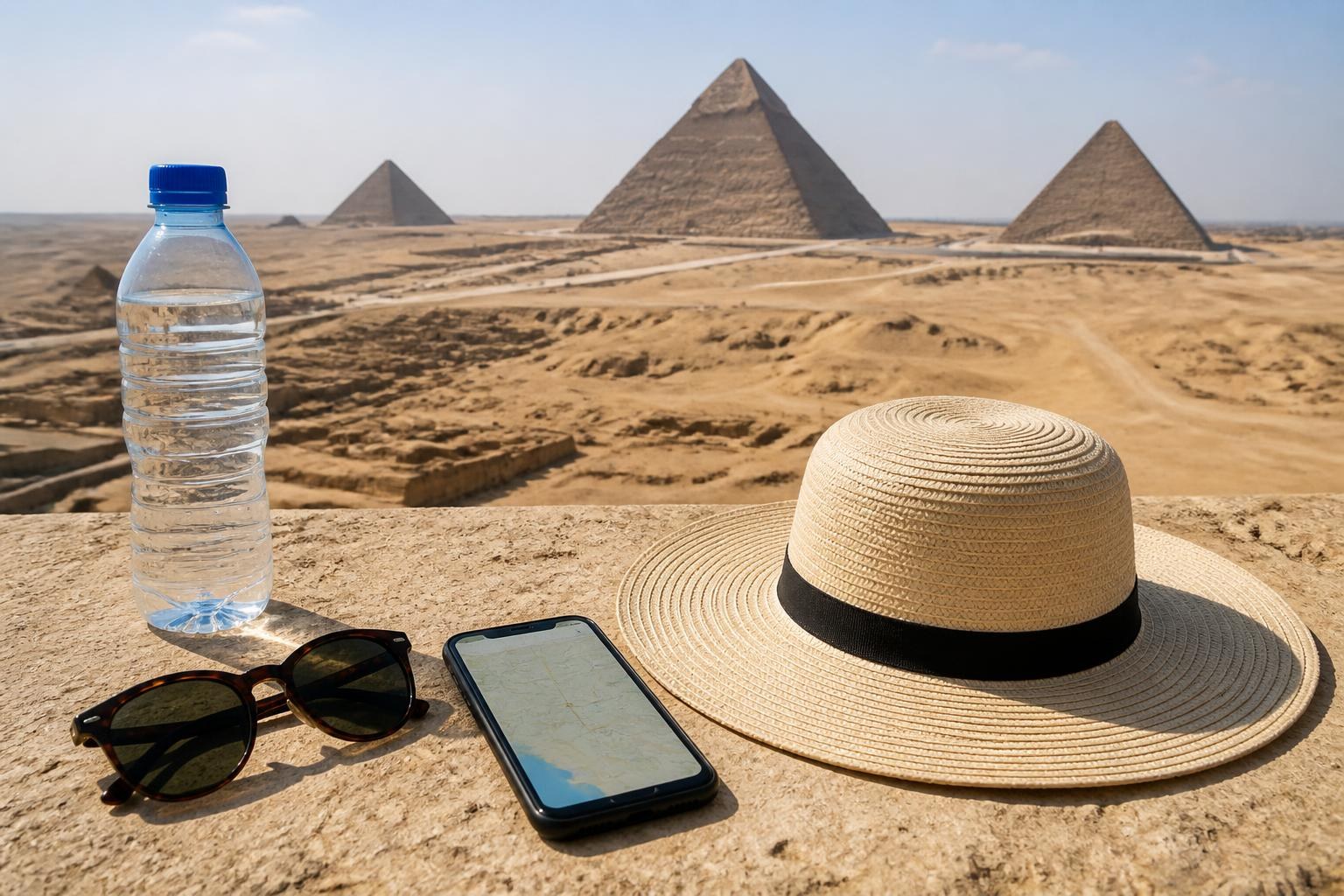
- Bring a hat, sunglasses and high-factor sunscreen.
- Carry water in a reusable bottle, but avoid overloading yourself.
- Bring a light layer for cooler winter mornings and evenings.
- Keep valuables secure and avoid displaying large amounts of cash.
- Use marked visitor routes and follow instructions around closed or protected areas.
Dress respectfully and ask before photographing workers, guides, camel handlers or other visitors. Do not climb monuments or touch fragile surfaces. The stone has survived for thousands of years, but it is not indestructible, and responsible behaviour helps protect the site for future visitors.
Guides, camel rides and avoiding pressure
Local services can add character to a Giza visit, but they are not essential. If you want a guide, agree on the price, duration, language and itinerary before starting. Clarify whether the service includes transport around the plateau or only walking commentary.
Camel and horse rides are offered in and around the Giza area. If you choose one, confirm the total price, length of the ride, route and payment terms before mounting. Ask to see the animal’s condition and avoid any arrangement that feels rushed or uncomfortable. You are always entitled to decline a service politely and continue walking.
Be cautious with unsolicited offers of “special entrances,” free tours or unusually cheap rides. Keep your plans simple: state what you want, agree to a price in advance and leave if the arrangement changes. A calm, firm “no, thank you” is usually enough.
If you want mobile data ready before you arrive, compare our eSIM Egypt plans and choose the plan that fits your trip.
Photography at the pyramids
The most recognisable photographs are not always taken closest to the stonework. Step back at the plateau viewpoints to show the scale of the monuments, then take time for details such as weathered blocks, remaining casing stones and the desert edge.
Early or late light generally produces more texture than bright midday sun. A phone is sufficient for most visitors, but a wide-angle lens helps in tight spaces and a zoom lens can frame the Sphinx or distant city without crossing barriers. Check current rules before using tripods, professional equipment or drones; drone use around archaeological sites is not something to assume is permitted.
Take a few moments without the camera. The plateau is visually overwhelming, and the most useful memory may be the sound of the city, the scale of the empty space and the changing colour of the limestone.
A practical half-day itinerary
Start: Arrive early at the official entrance and allow time for ticket checks. Begin with the Great Pyramid of Khufu while the temperature is still comfortable.
Next: Continue towards Khafre and Menkaure, stopping at a broad viewpoint where you can understand the relationship between the three pyramids. If you have an interior ticket, plan the entry around your energy and tolerance for confined spaces rather than trying to fit it in at the last minute.
Mid-visit: Take a water break in a shaded or suitable rest area. Avoid spending the entire visit walking in direct sun without pauses.
Finish: Visit the Sphinx and its surrounding viewing area, then leave before the hottest part of the day if possible. You can spend the afternoon in an indoor Cairo attraction, have lunch or return to your accommodation to rest.
If you have a full day, combine Giza with another Cairo plan only if the transport is realistic. Adding too many major sites creates a rushed day, particularly when traffic is heavy.
For reliable supporting context on this point, see Memphis and its Necropolis – the Pyramid Fields from Giza to Dahshur — UNESCO World Heritage Centre.
Connectivity and useful phone preparation
Mobile connectivity is useful at Giza for more than posting photographs. You may need directions to the correct entrance, a translation tool, a ride-hailing service, a map for the plateau or a message to your driver after leaving. Reliable data also helps if your itinerary changes because of heat, traffic or ticket availability.
Before visiting, download an offline map of Cairo and save your hotel name and address in both English and Arabic if possible. Keep screenshots of reservations and transport details. If your phone supports eSIM, arranging mobile data before arrival can be convenient; otherwise, local SIM options are available in Egypt. Check that your phone is unlocked and compatible before relying on any mobile plan.
Do not depend entirely on Wi-Fi. The plateau is open and exposed, and public connectivity may not be available exactly when you need it. Carry a power bank, especially if you are using navigation, translation and photography throughout the day.
What to do nearby
The Giza Plateau can be combined with other attractions in the wider Giza and Cairo area, but choose based on your energy and transport time. The Grand Egyptian Museum area is relevant to many visitors planning a pyramid day, though access, exhibitions and operating details should be checked before travelling. You can also use the afternoon for a calmer meal or a rest at your accommodation rather than immediately adding another long excursion.
Travellers with more time can plan a separate day for Cairo’s historic districts and museums. Separating the pyramid visit from central Cairo sightseeing usually creates a more comfortable itinerary because both require attention, walking and time in traffic.
Recommended internal reading
For wider trip planning, continue with our Cairo Travel Guide: Attractions, Areas and Practical Tips, which covers neighbourhoods, transport, food, safety and connectivity. If you are arranging your arrival first, read Cairo Airport to the City: Transport Options and Costs. Our Egypt Travel Guide for First-Time Visitors is useful for building a route beyond Cairo, while Best Time to Visit Egypt: Weather, Crowds and Regional Advice can help you choose the most comfortable season.
The pyramids are not difficult to visit, but they reward realistic expectations. Arrive prepared for heat, distance and attention from service providers, leave room in your schedule and give yourself time to experience the plateau rather than simply checking it off a list.
Frequently Asked Questions
How long do I need at the Pyramids of Giza?
Allow at least three to four hours for the main plateau, viewpoints and Sphinx. Add more time if you want to enter a pyramid, hire a guide, take a camel ride or explore slowly.
What is the best time of day to visit the pyramids?
Early morning is usually the most comfortable choice because temperatures are lower, the light is softer and you can complete more outdoor walking before the strongest heat. Check current opening and ticket information before you go.
Can I enter the Great Pyramid?
Interior access is controlled separately from general sightseeing and may require an additional ticket or specific arrangements. Confirm the current rules and ticket categories with the Ministry of Tourism and Antiquities before your visit.
Is a guide necessary at Giza?
No. Independent visitors can see the main monuments with advance preparation. A reputable guide can add historical context and help with logistics, but agree on the itinerary and price before starting.
What should I bring to the Pyramids of Giza?
Bring water, sunscreen, a hat, sunglasses, comfortable closed shoes, a charged phone and a power bank. Offline maps and saved hotel and transport details are also useful if mobile coverage or Wi-Fi is inconsistent.